 Nayan
78b48e7ca4
`airship doctor` had one `git repo` line that reported `isGitRepo` and nothing
else, so a machine with no git on PATH was told it was not in a repository.
That is now two checks, because they fail for different reasons and have
different fixes: whether git can run at all, and whether this directory is
somewhere it can usefully run.

The level follows the rule `checkAgents` already set — only the backend being
used can fail the run. Claude snapshots its own before-state through a pre-tool
hook and edits and undoes with no git at all, so a working Claude install must
not be reported as broken; codex and opencode reconstruct their baseline from
HEAD and cannot. `doctor` exits non-zero on any fail and is documented as
scriptable, which is what that distinction protects.

The launch banner's git warning becomes unconditional. It used to fire only for
the non-Claude backends, but whatever is wrong with git breaks Commit and
Create pull request on every one of them; the diff-baseline sentence is the
half that really is backend-specific.

`--debug` had no consumer but `reportError`'s stack print. It now also prints
every failed git invocation to stderr with its argv, exit status and full
stderr — the detail behind the one line a toast has room for. stderr, so
`--json` stays parseable, and `AIRSHIP_DEBUG=1` works without changing how the
daemon is launched, which matters when the person who needs the trace is not
the person who knows the flags.

`isGitRepo` leaves @airship/server's exports with its last consumer. It stays
in @airship/git as the cheap predicate `commitEdit` takes before paying for a
`gitStatus`; it is no longer what anything user-facing asks, because it answers
"false" to three different problems.

Also: gen-models.mjs spawned `node_modules/.bin/biome`, the POSIX shell
wrapper, with no shell and no `.CMD` fallback — the last un-forked spawn in the
repo. Only reachable through `make models:refresh`, so it never failed in CI.
580 lines
27 KiB
Markdown
580 lines
27 KiB
Markdown
<!-- Generated from the root README.md by scripts/sync-readme.mjs. Do not edit. -->
|
|
|
|
# Airship
|
|
|
|
[](https://www.npmjs.com/package/@airshiplabs/cli)
|
|
[](https://nodejs.org)
|
|
[](https://github.com/0xnyn/airship/blob/main/LICENSE)
|
|
|
|
**Visual editor for your codebase.**
|
|
|
|
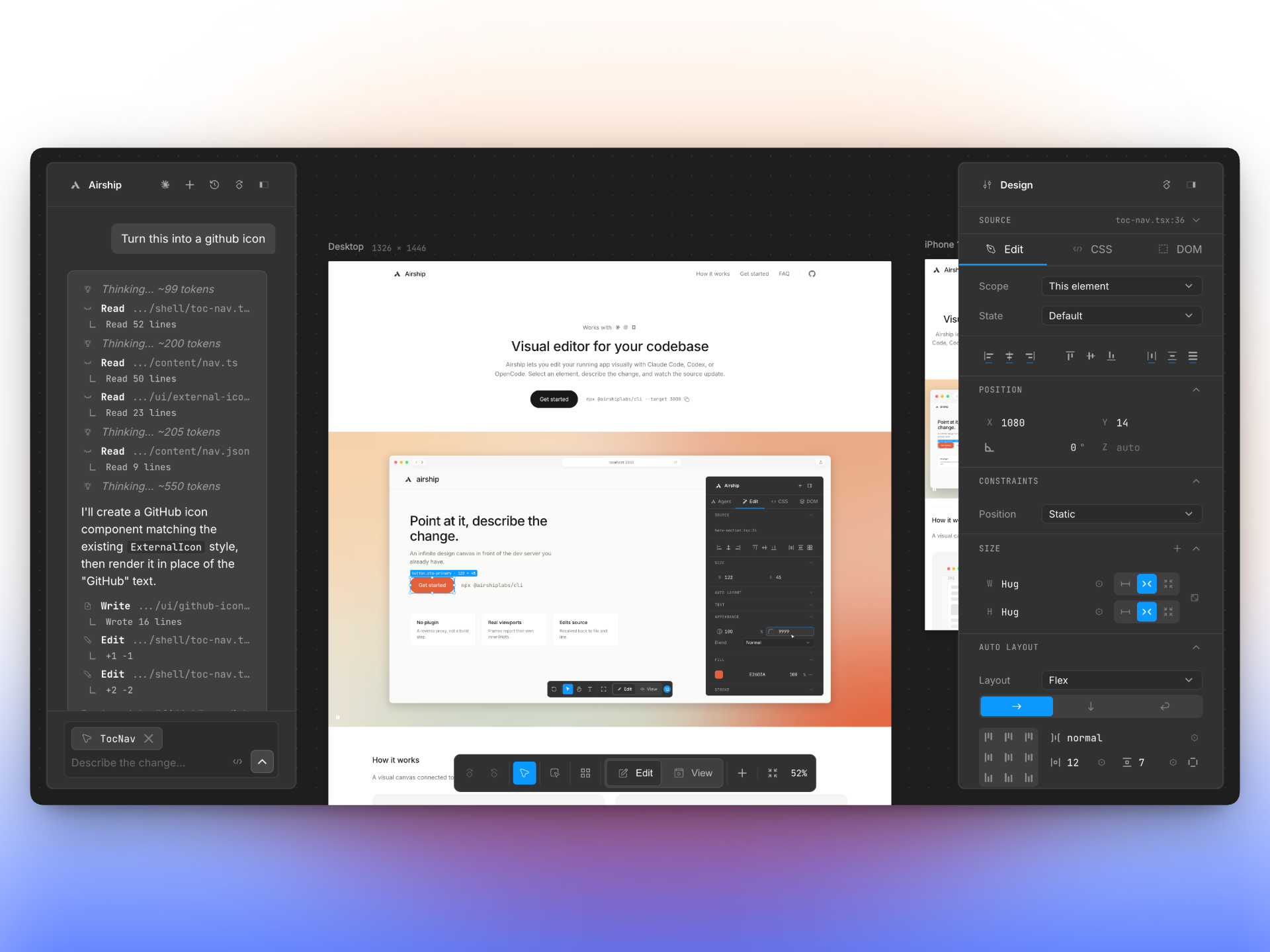
Airship puts an infinite design canvas in front of your dev server. Select an element, describe
|
|
the change, and watch Claude Code, Codex or OpenCode update the source — without rebuilding your
|
|
UI in a separate design tool.
|
|
|
|
|
|
|
|
```bash
|
|
npx @airshiplabs/cli --target 3000
|
|
```
|
|
|
|
No plugin. No config. Nothing added to your dependencies or your bundle.
|
|
|
|
[airship.design](https://airship.design) · [CLI reference](#cli-reference) · [Configuration](#configuration) · [Questions](#questions)
|
|
|
|
---
|
|
|
|
## Quick start
|
|
|
|
|
|
|
|
**1. Start your app the way you always do.**
|
|
|
|
```bash
|
|
pnpm dev # http://localhost:3000
|
|
```
|
|
|
|
Works with Vite, Next, Remix, Rails, or anything that serves HTML over HTTP. No plugins
|
|
required.
|
|
|
|
**2. Point Airship at your dev server.**
|
|
|
|
```bash
|
|
npx @airshiplabs/cli --target 3000
|
|
```
|
|
|
|
Airship connects to the port you're already running and opens the visual editor on the next
|
|
free port. Or install it once and use the `airship` binary:
|
|
|
|
```bash
|
|
npm i -g @airshiplabs/cli
|
|
airship --target 3000
|
|
```
|
|
|
|
**3. Bring your coding agent.**
|
|
|
|
```bash
|
|
airship --target 3000 --agent codex --safe
|
|
```
|
|
|
|
Pick the agent you already use and start making changes without running a separate agent
|
|
interface.
|
|
|
|
Airship uses the authentication you already have configured for Claude Code, Codex, or
|
|
OpenCode. Run `airship doctor` if something does not work.
|
|
|
|
### Or let it start your dev server too
|
|
|
|
`--exec` starts your dev server and stops it again when Airship exits. Leave `--target` off and
|
|
it reads the port from your `package.json`:
|
|
|
|
```bash
|
|
airship --exec "pnpm dev"
|
|
```
|
|
|
|
Run `airship` on its own and it just asks you for the port, the agent and the mode.
|
|
|
|
## What it is
|
|
|
|
A CLI, and nothing else.
|
|
|
|
- **Nothing goes into your project.** Airship runs in front of the dev server you already have.
|
|
Your build, your config and your dependencies are untouched.
|
|
- **Every frame is a real browser window.** A phone frame behaves like a phone, however far you
|
|
zoom out. Mobile and desktop sit side by side — both live, both editable, one source file.
|
|
- **Changes land in your code.** Click an element and Airship knows the file and line that drew
|
|
it. Describe the change, get the diff, undo it if you don't like it.
|
|
- **Nothing leaves your machine.** No account, no telemetry, no service to sign up for.
|
|
|
|
|
|
|
|
|
|
## Canvas or inline
|
|
|
|
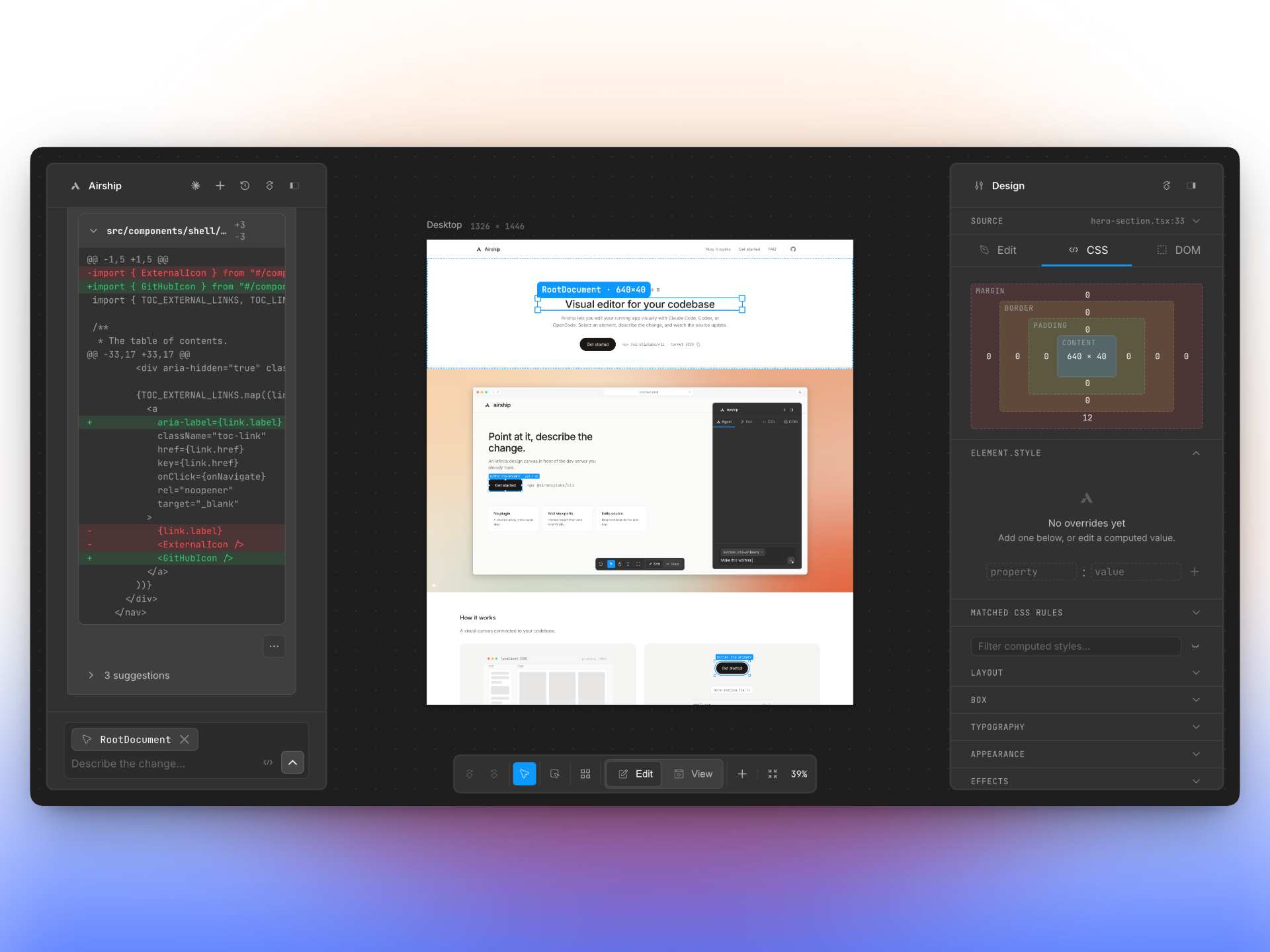
Two ways to look at your app. Same editor either way.
|
|
|
|
**`canvas`** (default) — your app on a pannable canvas, one live frame per device size.
|
|
|
|
|
|
|
|
**`inline`** — the editor on top of your own page, one window.
|
|
|
|
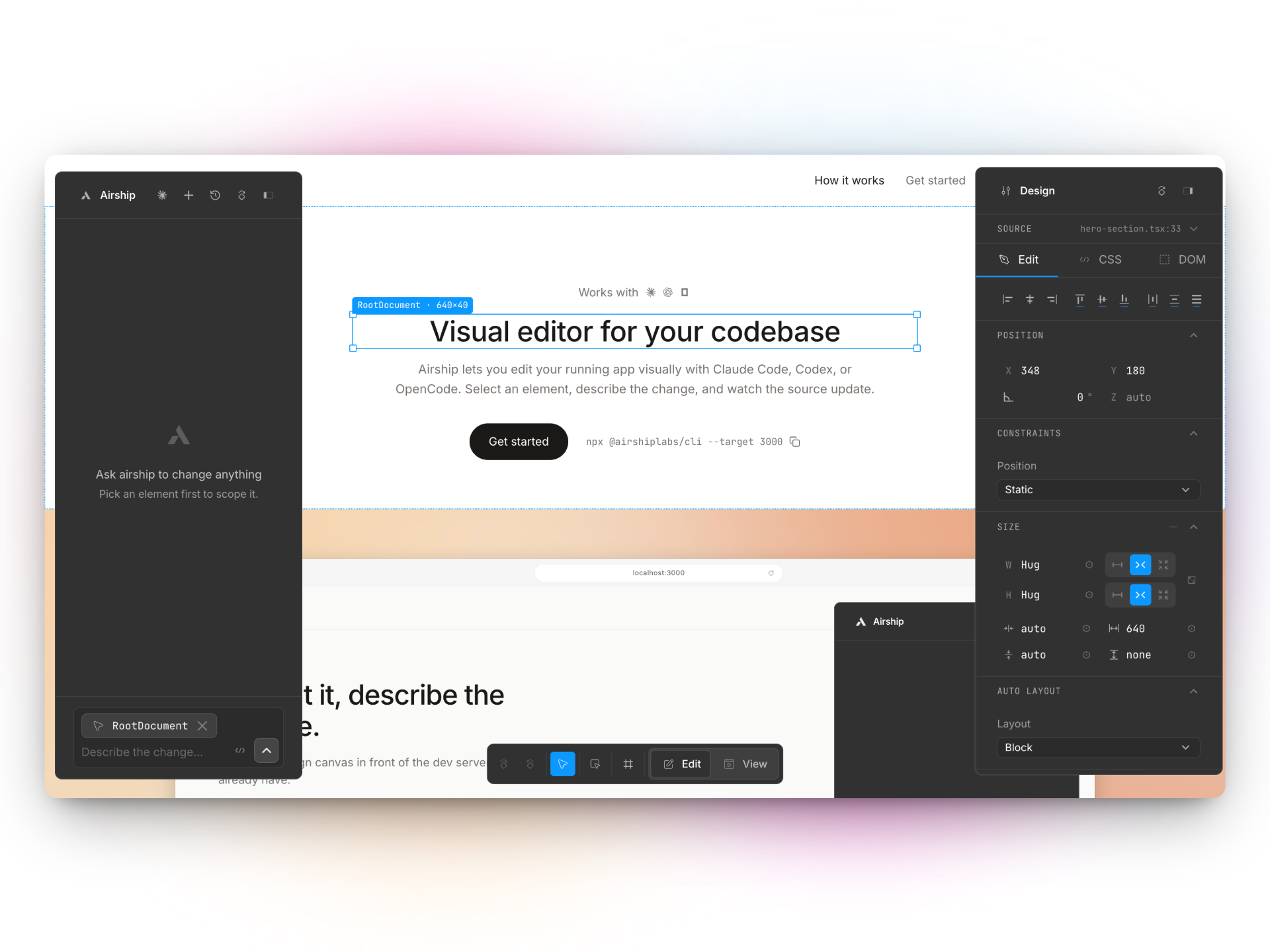
|
|
|
|
Pick one at launch with `airship --mode inline`, or switch any time from the bottom bar. Your
|
|
choice sticks across reloads and as you click around your app. Add `?__airship=inline` to a URL
|
|
to try the other one once, without changing your preference; `?__airship=shell` is the way back
|
|
to the canvas — the parameter takes the internal mode name, so it is `shell`, not `canvas`.
|
|
|
|
Open any route of your app in Airship — `/pricing`, `/settings` — and every frame opens there.
|
|
|
|
The controls, in short — the table below is generated from the editor's own command
|
|
catalog, so it cannot drift from what the keys actually do:
|
|
|
|
<!-- controls:start -->
|
|
| | macOS | Windows / Linux |
|
|
| --- | --- | --- |
|
|
| pan the canvas | Wheel / two-finger | Wheel / two-finger |
|
|
| zoom at the cursor | ⌘-wheel / pinch | Ctrl-wheel / pinch |
|
|
| pan without the hand | Space-drag | Space-drag |
|
|
| select an element | Click | Click |
|
|
| edit text in place | Double-click | Double-click |
|
|
| open the element menu | Right-click | Right-click |
|
|
| scrub a number | Drag a field's glyph | Drag a field's glyph |
|
|
| undo | ⌘Z | Ctrl+Z |
|
|
| delete element | ⌫ or Del | Backspace or Del |
|
|
| duplicate | ⌘D | Ctrl+D |
|
|
| edit text | ↩ or T | Enter or T |
|
|
| move | V | V |
|
|
| inspect | I | I |
|
|
| zoom in | ⌘= or = | Ctrl+= or = |
|
|
| zoom out | ⌘- or - | Ctrl+- or - |
|
|
| zoom to 100% | ⌘0 or ⇧0 | Ctrl+0 or Shift+0 |
|
|
| zoom to fit | ⇧1 | Shift+1 |
|
|
| hand tool | H | H |
|
|
| add a frame | F | F |
|
|
| send | ⌘↩ | Ctrl+Enter |
|
|
| keyboard shortcuts | ? | ? |
|
|
| command palette | ⌘K | Ctrl+K |
|
|
|
|
Press `?` in the editor for all of them, or see [CONTROLS.md](https://github.com/0xnyn/airship/blob/main/CONTROLS.md).
|
|
<!-- controls:end -->
|
|
|
|
## Edit and View
|
|
|
|
The two modes point the editor at different things, and the panels follow.
|
|
|
|
**Edit** is about an element: hover to highlight, click to select, and the agent panel and
|
|
inspector are open on either side of it.
|
|
|
|
**View** is about your frames. The page underneath is fully interactive — click through it,
|
|
fill in forms, scroll — so there is no element selection, and the two panels that depend on
|
|
one step aside. In their place the left panel lists every frame, and a minimap appears in
|
|
the bottom-right corner:
|
|
|
|
- Click a frame in the list to go to it without changing your zoom; double-click to zoom
|
|
to it. Rename it in place, and use `⋯` for its device size, rotate, duplicate and delete.
|
|
- The list is stacking order, front-most at the top. Drag a row anywhere along it — or
|
|
press ↑↓ on its handle — to restack frames that overlap on the canvas; up is forward.
|
|
- Drag the minimap's indicator and the canvas travels with it; press anywhere else on the
|
|
map to jump there. Pan far off your frames and it keeps pointing back at them.
|
|
|
|
Your panel arrangement is remembered per mode, so switching back returns the inspector
|
|
exactly as you left it.
|
|
|
|
## Inspector
|
|
|
|
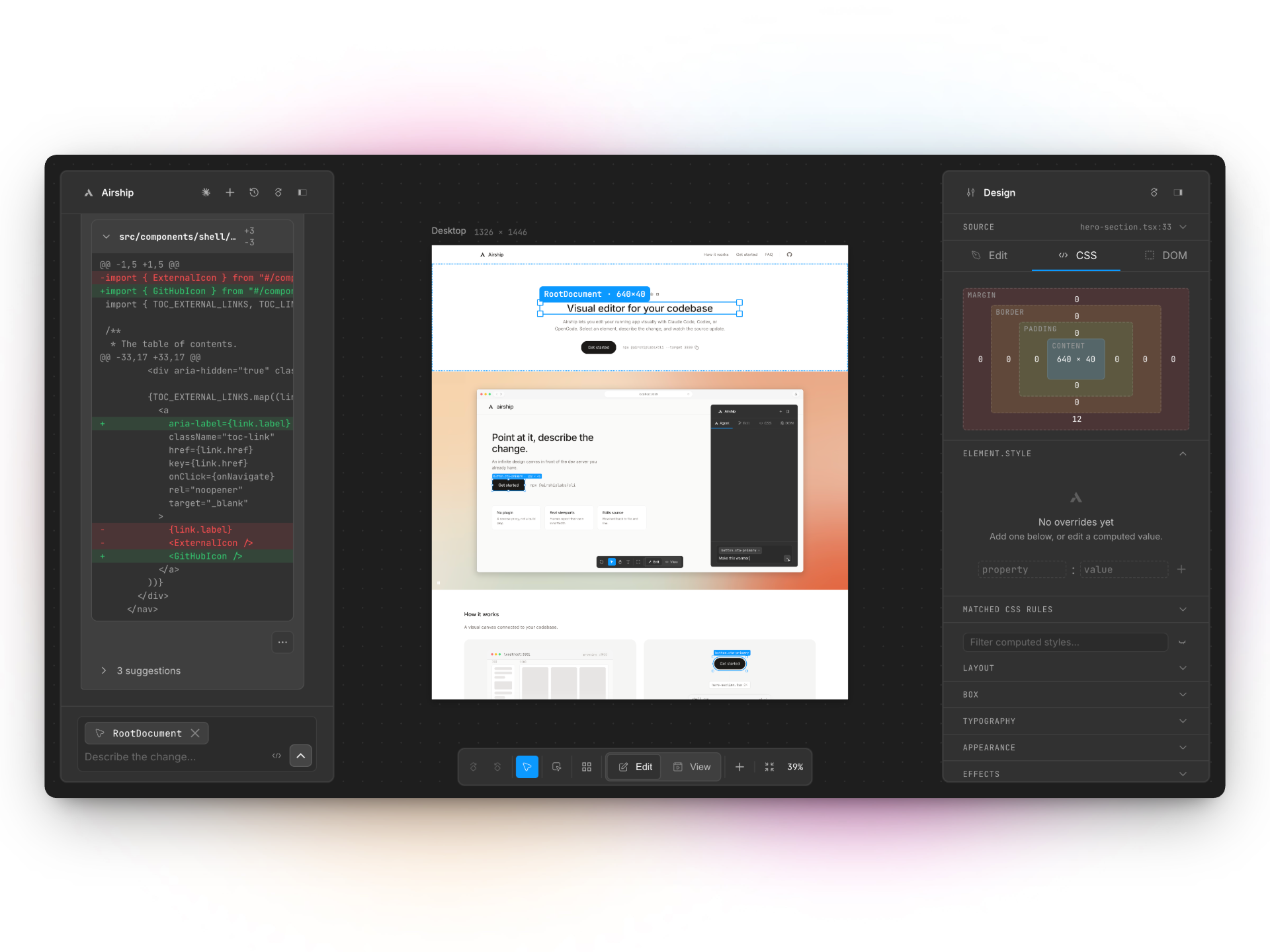
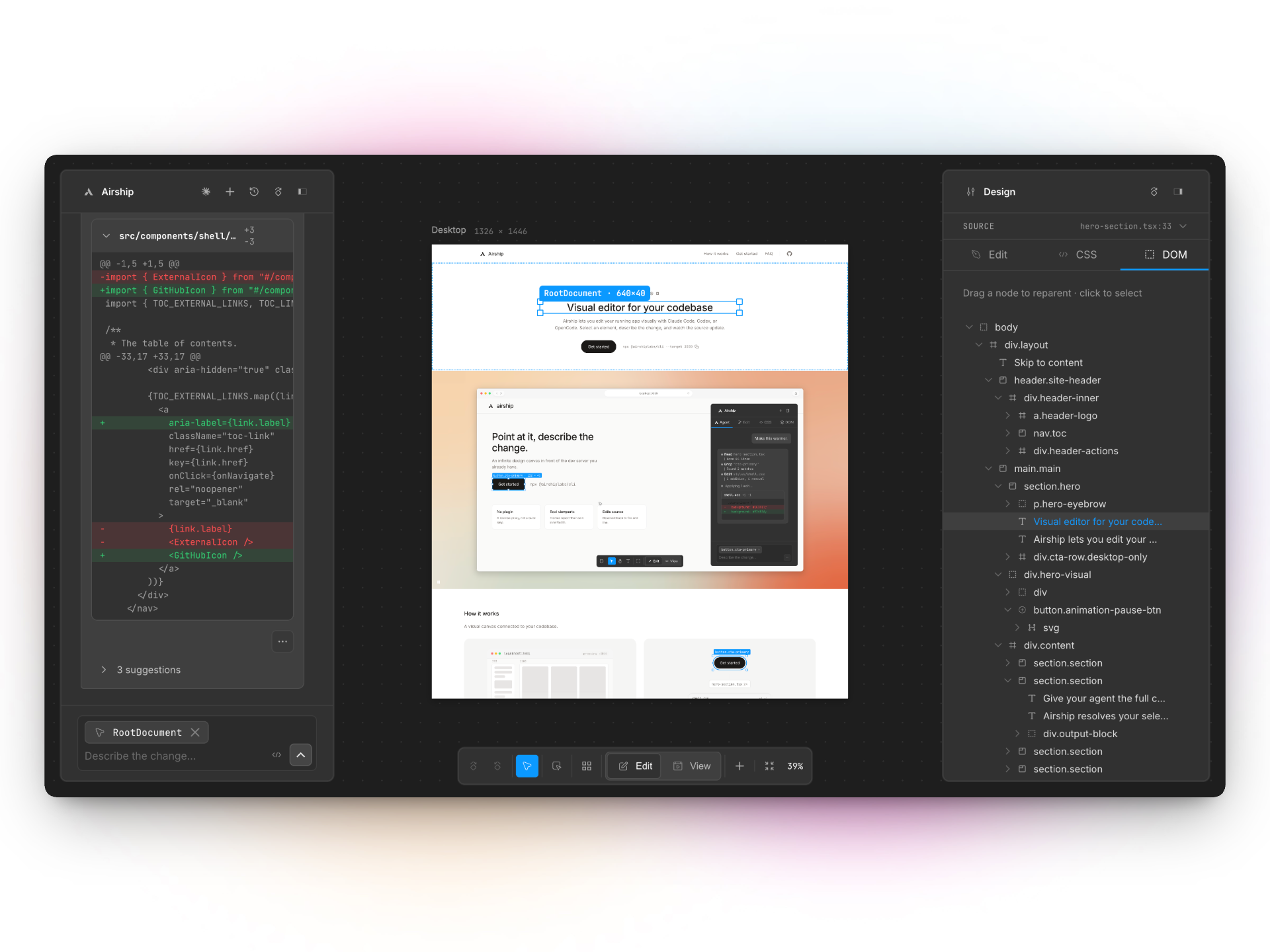
Click an element and it fills the inspector. Every tab is looking at the same thing.
|
|
|
|
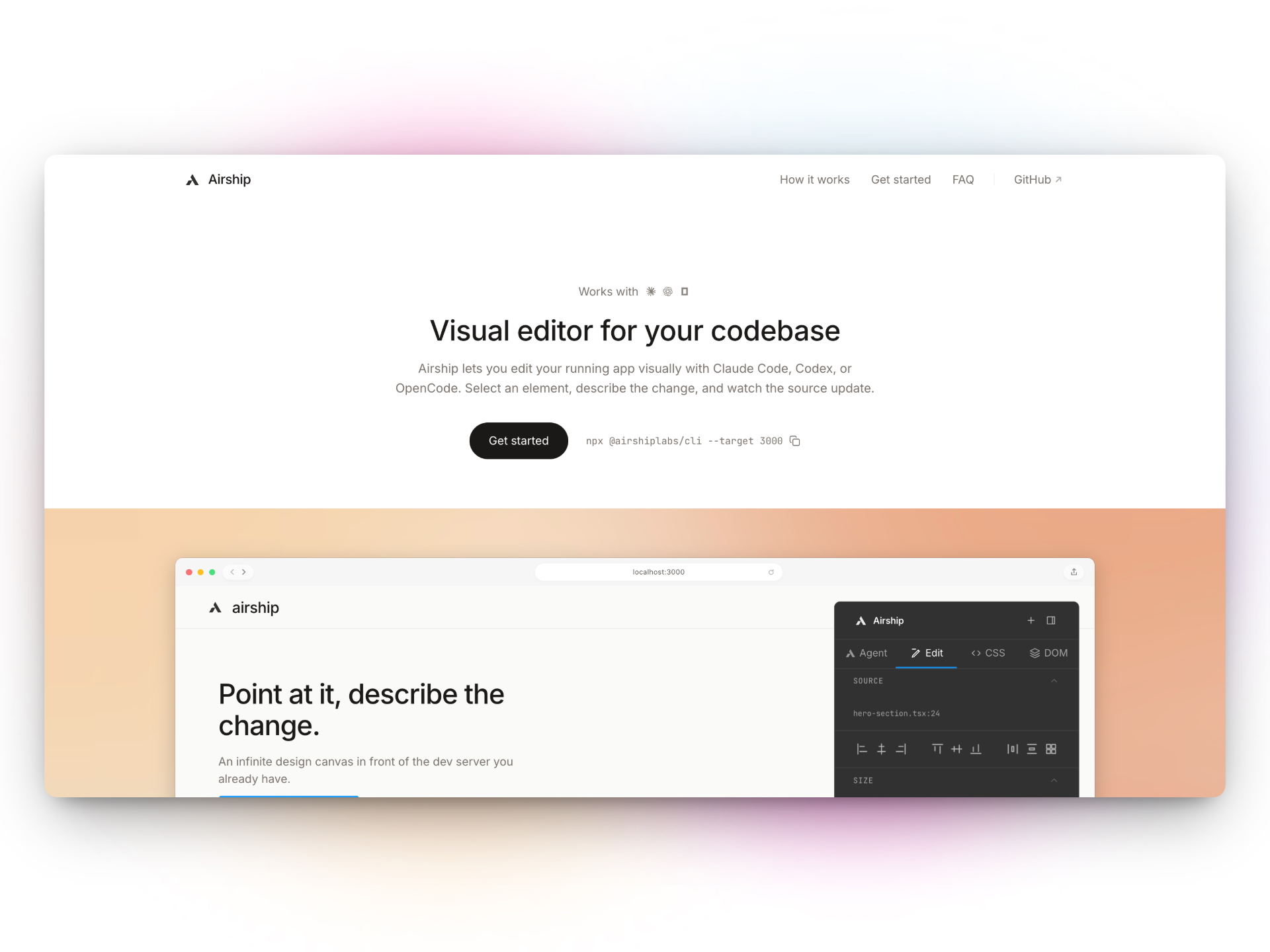
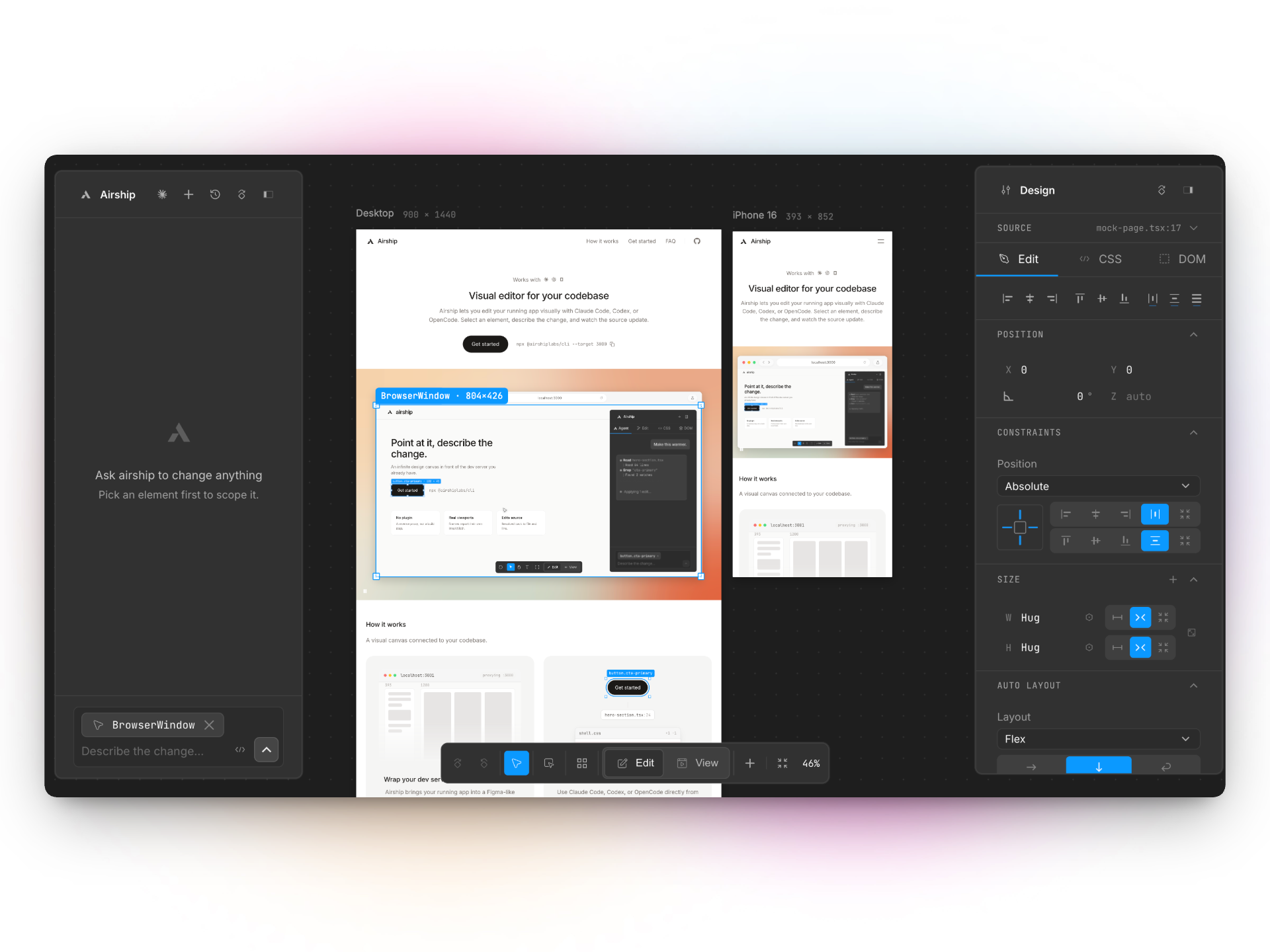
`Edit` is position, size, spacing and layout — the shot up in [Quick start](#quick-start). `CSS`
|
|
is the box model, the rules that are actually hitting the element, and your own tweaks on top:
|
|
|
|
|
|
|
|
`DOM` is the tree. Click a node to select it, or drag one to move it somewhere else:
|
|
|
|
|
|
|
|
## Agents
|
|
|
|
Pick one with `--agent`, or switch between them as you go. They are not equal, and Airship tells
|
|
you what you're giving up at startup.
|
|
|
|
| | `claude` (default) | `codex` | `opencode` |
|
|
| --- | --- | --- | --- |
|
|
| Watch it write | word by word | the whole reply at once, at the end | word by word |
|
|
| Pick up an old chat | yes | yes | yes |
|
|
| Branch off a chat | yes | starts fresh, and says so | yes, history kept |
|
|
| Shows what it cost | in dollars | tokens only | in dollars |
|
|
| `--effort` | yes | yes | **ignored** |
|
|
| `--max-turns`, `--max-budget` | yes | **ignored** | **ignored** |
|
|
| `--model` | a model name | a model name | needs the `provider/model` form |
|
|
| Lists its own models | yes | **no** — Airship ships a list | yes, the ones you are signed in to |
|
|
| `--safe` | checks each edit and command | **real sandbox** | asks before each edit and command |
|
|
| Install | included | included | **you install it yourself** |
|
|
|
|
Undo is Airship's, not the agent's. It keeps the previous version of every file it touches, so
|
|
undo works on all three. One catch: `codex` and `opencode` get that previous version from Git,
|
|
so **undo needs your project to be a Git repo on those two**. Airship warns you at startup.
|
|
|
|
One more `opencode` quirk: the one-line summary and the follow-up suggestion chips come from a
|
|
JSON block the model is asked to append to its reply. A model that ignores the instruction
|
|
loses the chips and gets a plainer commit message — never the edit itself. Models with thinking
|
|
enabled reject opencode's own structured-output request outright; Airship detects that, retries
|
|
the turn without it, and remembers not to ask that model again.
|
|
|
|
### Authentication
|
|
|
|
Airship reuses whatever the chosen agent already has, and warns at startup if it finds nothing.
|
|
|
|
| Agent | Needs one of |
|
|
| --- | --- |
|
|
| `claude` | `ANTHROPIC_API_KEY`, `CLAUDE_CODE_OAUTH_TOKEN`, or a `claude` login (`~/.claude`) |
|
|
| `codex` | `CODEX_API_KEY`, `OPENAI_API_KEY`, or a `codex login` (`~/.codex/auth.json`) |
|
|
| `opencode` | the `opencode` binary on PATH, **plus** a provider key or an `opencode auth login` |
|
|
|
|
OpenCode is a separate install — `brew install sst/tap/opencode` or `npm i -g opencode-ai` —
|
|
and accepts `ANTHROPIC_API_KEY`, `OPENAI_API_KEY`, `OPENCODE_API_KEY`, `OPENROUTER_API_KEY`,
|
|
`GEMINI_API_KEY`, `GOOGLE_GENERATIVE_AI_API_KEY`, `AWS_BEARER_TOKEN_BEDROCK` or
|
|
`AWS_ACCESS_KEY_ID`.
|
|
|
|
## Safety
|
|
|
|
**By default the agent runs unsandboxed.** It can write anywhere you can and reach the network —
|
|
the same access it has when you run it from your terminal. Pass `--safe` to confine it:
|
|
|
|
| | default | `--safe` |
|
|
| --- | --- | --- |
|
|
| `codex` | full access, network on | locked to your project folder, no network, no web search |
|
|
| `claude` | full access, no sandbox | edits kept inside your project, dangerous commands blocked |
|
|
| `opencode` | full access | asks before every edit and command, checked the same way; no web fetch, no web search, nothing outside your project |
|
|
|
|
`--safe` is not equally strong on all three, and the CLI says so at launch:
|
|
|
|
- **Only `codex` gets a real sandbox.** The operating system stops it writing outside your
|
|
project. On `claude` and `opencode`, Airship checks each edit and command first — a good
|
|
check, but a check, not a wall.
|
|
- **That check looks for known-dangerous commands; it does not understand shell.** It catches
|
|
`rm -rf`. It does not catch a write pointed somewhere else, like `echo x > /elsewhere`.
|
|
- **`claude` and `opencode` can still reach the network.** Airship switches off their web tools,
|
|
but nothing stops a command they run from opening a connection anyway. Only a sandbox can.
|
|
|
|
If a hard guarantee matters more to you than which agent you use, run
|
|
`airship --agent codex --safe`.
|
|
|
|
Diffs and undo work the same either way — `--safe` has no effect on them.
|
|
|
|
## CLI reference
|
|
|
|
```
|
|
airship [options]
|
|
airship --target <port> [options]
|
|
airship <command> [options]
|
|
```
|
|
|
|
| Command | |
|
|
| --- | --- |
|
|
| `airship` | Launch the visual editor against your dev server. Bare at a terminal, it asks first. |
|
|
| `airship init` | Create an `airship.config.json` for this project. |
|
|
| `airship doctor` | Check your environment and report what is wrong. |
|
|
|
|
Flags accept `--flag value` and `--flag=value`, a camelCase spelling of any kebab name
|
|
(`--maxTurns` ≡ `--max-turns`), and `--no-<name>` to turn any boolean off. A bare `--` stops flag
|
|
parsing — airship takes no positional arguments, so anything after it is ignored rather than
|
|
forwarded.
|
|
|
|
### Core
|
|
|
|
| Flag | | Default |
|
|
| --- | --- | --- |
|
|
| `-t, --target <port>` | Port your dev server is already running on. Detected from your `package.json` when omitted. | |
|
|
| `-p, --port <port>` | Port for the airship proxy. | `target + 1` |
|
|
| `--host <address>` | Interface the proxy listens on. See [`--host`](#--host) before widening it. | `127.0.0.1` |
|
|
| `--allowed-hosts <names>` | Extra hostnames airship answers to, repeatable or comma-separated. `localhost` and IP addresses are always allowed. | |
|
|
| `--cwd <dir>` | Project root for edits. | current directory |
|
|
| `--mode <name>` | Editor mode: `canvas` or `inline`. Switchable from the editor too. | `canvas` |
|
|
| `--exec <command>` | Start your dev server with this command and stop it when airship exits. | |
|
|
| `--open` | Open the editor in your browser once it is listening. | |
|
|
| `--keep-csp` | Keep your app's `Content-Security-Policy` on editor surfaces instead of stripping it. Framing headers (`X-Frame-Options`) are always stripped. | off |
|
|
|
|
### Agent
|
|
|
|
| Flag | | Default |
|
|
| --- | --- | --- |
|
|
| `-a, --agent <name>` | Coding agent: `claude`, `codex`, `opencode`. | `claude` |
|
|
| `-m, --model <id>` | Model for whichever agent runs. Per-backend flags below outrank it. | the agent's own default |
|
|
| `--effort <level>` | Reasoning effort: `minimal`, `low`, `medium`, `high`, `xhigh`, `max`. | |
|
|
| `--max-turns <n>` | Cap agent turns per edit (claude only). | `24` |
|
|
| `--max-budget <usd>` | Stop an edit if it exceeds this cost in USD (claude only). | |
|
|
| `--commit` | Auto-commit each accepted edit (Conventional Commits). | |
|
|
|
|
`-m` is `--model`, not `--mode`. `--mode` has no short alias.
|
|
|
|
You can also pick the model from the editor. The agent button in the chat header opens a
|
|
group per backend; choosing a row picks the backend **and** its model in one go, and a box
|
|
at the bottom takes any id the list does not offer. That choice is per backend and is
|
|
remembered, so switching between them does not carry one backend's model to another. The
|
|
flags below are the resting default it starts from.
|
|
|
|
### Sandbox
|
|
|
|
| Flag | | Default |
|
|
| --- | --- | --- |
|
|
| `--safe` | Confine edits to the project directory and cut network access. See [Safety](#safety). | off |
|
|
|
|
### Backend
|
|
|
|
| Flag | | Default |
|
|
| --- | --- | --- |
|
|
| `--claude-model <id>` | Model for the `claude` backend. Takes an alias or a full id. | `--model`, then the agent's own |
|
|
| `--codex-model <id>` | Model for the `codex` backend. | `--model`, then the agent's own |
|
|
| `--opencode-model <provider/model>` | Model for the `opencode` backend. Needs the `provider/model` form. | `--model`, then the agent's own |
|
|
| `--codex-path <path>` | Path to the `codex` binary. | bundled |
|
|
| `--codex-config <k=v>` | Extra `codex --config` pair; repeatable. | |
|
|
| `--opencode-path <path>` | Path to the `opencode` binary. | found on PATH |
|
|
| `--opencode-url <url>` | Attach to a running `opencode serve` instead of starting one. | |
|
|
| `--opencode-agent <name>` | Run as a named opencode agent. | its own |
|
|
| `--opencode-config <file>` | JSON file merged into the opencode server config. | |
|
|
|
|
`--codex-config` reads the shape of the value: `true`/`false` become TOML booleans and anything
|
|
numeric becomes a number, so `--codex-config network_access=true` sends a boolean, not the string.
|
|
Quote it — `--codex-config k='"true"'` — to keep a string a string.
|
|
|
|
### Global
|
|
|
|
| Flag | |
|
|
| --- | --- |
|
|
| `--json` | Machine-readable JSON on stdout, no colour and no banner. |
|
|
| `-q, --quiet` | Suppress the launch banner. Warnings still print. |
|
|
| `--debug` | Print stack traces, and every git command that failed. |
|
|
| `-h, --help` | Show this help. |
|
|
| `-v, --version` | Print the version. |
|
|
|
|
Banners, warnings and errors go to stderr; `--json` payloads, help and `--version` go to stdout,
|
|
so `airship --json | jq` is reliable.
|
|
|
|
### `airship init`
|
|
|
|
Writes an `airship.config.json` from the same questions the bare `airship` wizard asks, so it
|
|
stops asking. Takes `--cwd` and the global flags. Needs a terminal.
|
|
|
|
### `airship doctor`
|
|
|
|
Checks, in order: `node`, `airship`, `config`, `git`, `git repo`, `overlay bundle`,
|
|
`agent claude`, `agent codex`, `agent opencode`, `dev server`. Each reports `ok`, `warn` or
|
|
`fail` with a hint. Only your preferred agent (`--agent`, default `claude`) can fail the run;
|
|
the other two warn.
|
|
|
|
`git` and `git repo` are separate because they fail for different reasons and have different
|
|
fixes: whether git can run at all, and whether this directory is somewhere it can usefully run
|
|
(a work tree, with at least one commit, and a configured `user.name` / `user.email`). They fail
|
|
the run on `--agent codex` and `--agent opencode`, which reconstruct their diff baseline from
|
|
`HEAD`, and warn on `claude`, which snapshots its own before-state and needs no git to edit or
|
|
undo.
|
|
|
|
Exits `1` if any check failed, so `airship doctor && airship` works. Takes `--cwd`, `--target`,
|
|
`--agent` and the global flags. `--json` prints the same checks as a machine-readable record,
|
|
which is the most useful thing to send someone when a run is failing on a machine you cannot
|
|
see.
|
|
|
|
### Exit codes
|
|
|
|
| Code | |
|
|
| --- | --- |
|
|
| `0` | Fine. |
|
|
| `1` | Something failed. |
|
|
| `2` | Bad flag, bad value, or a terminal was needed and there wasn't one. |
|
|
| `127` | Not an airship command. |
|
|
| `130` | Interrupted — Ctrl-C, or a cancelled prompt. |
|
|
|
|
## Configuration
|
|
|
|
Settings resolve in this order, highest first:
|
|
|
|
```
|
|
flags → AIRSHIP_* environment → airship.config.json → defaults
|
|
```
|
|
|
|
### The config file
|
|
|
|
`airship.config.json`, or an `"airship"` key in your `package.json`. Run `airship init` to write
|
|
one. Every key is a flag name, in either kebab or camel case:
|
|
|
|
```json
|
|
{
|
|
"agent": "claude",
|
|
"mode": "canvas",
|
|
"target": 3000,
|
|
"safe": true,
|
|
"claudeModel": "opus",
|
|
"codexModel": "gpt-5.3-codex"
|
|
}
|
|
```
|
|
|
|
Models are keyed per backend — `claudeModel`, `codexModel`, `opencodeModel` — because the
|
|
editor's picker can switch backends mid-session, and one shared `model` would follow it and
|
|
hand Codex an id only Claude answers to. A plain `"model"` still works and applies to
|
|
whichever backend runs, with the per-backend keys taking precedence.
|
|
|
|
Airship looks for it from `--cwd` upwards and **stops at your repository root**, so a stray
|
|
config file somewhere above your repo won't affect you. Misspell a key and it says so, with a
|
|
suggestion — it never quietly ignores one.
|
|
|
|
### Environment
|
|
|
|
Every flag except `--help` and `--version` has an environment variable: `AIRSHIP_` plus the flag
|
|
name uppercased, with `-` as `_`.
|
|
|
|
```
|
|
AIRSHIP_TARGET AIRSHIP_AGENT AIRSHIP_CODEX_PATH
|
|
AIRSHIP_PORT AIRSHIP_MODEL AIRSHIP_CODEX_CONFIG
|
|
AIRSHIP_CWD AIRSHIP_EFFORT AIRSHIP_OPENCODE_PATH
|
|
AIRSHIP_MODE AIRSHIP_MAX_TURNS AIRSHIP_OPENCODE_URL
|
|
AIRSHIP_EXEC AIRSHIP_MAX_BUDGET AIRSHIP_OPENCODE_AGENT
|
|
AIRSHIP_OPEN AIRSHIP_COMMIT AIRSHIP_OPENCODE_CONFIG
|
|
AIRSHIP_SAFE AIRSHIP_JSON AIRSHIP_OPENCODE_MODEL
|
|
AIRSHIP_DEBUG AIRSHIP_QUIET AIRSHIP_CLAUDE_MODEL
|
|
AIRSHIP_KEEP_CSP AIRSHIP_HOST AIRSHIP_CODEX_MODEL
|
|
AIRSHIP_ALLOWED_HOSTS
|
|
```
|
|
|
|
`AIRSHIP_HELP` and `AIRSHIP_VERSION` are deliberately not read — exporting one would leave the
|
|
CLI unable to run anything. Booleans take `1`/`true`/`yes`/`on` or `0`/`false`/`no`/`off`;
|
|
anything else is an error rather than a guess.
|
|
|
|
Four more are honoured: `AIRSHIP_EDITOR` (`vscode`, `cursor`, `windsurf` or `zed` — which
|
|
editor "open in editor" prefers, otherwise probed in that order), `AIRSHIP_AGENT_DEBUG` (stream
|
|
the Claude backend's raw stderr to the terminal — separate from `--debug`, which logs airship
|
|
itself), and `NO_COLOR` / `FORCE_COLOR`.
|
|
|
|
`AIRSHIP_DEBUG=1` does what `--debug` does, which is worth knowing when the person who needs
|
|
the trace is not the person who typed the command. Both print every failed git invocation to
|
|
stderr with its argv, its exit status and the whole of its stderr — the detail behind the one
|
|
line a toast has room for.
|
|
|
|
### `--cwd`
|
|
|
|
`--cwd` is the folder your dev server treats as its root, which is not always your repository
|
|
root. Airship needs it to turn the paths your dev server reports (`/src/app.tsx`) into real
|
|
files on disk. In a monorepo where the app lives in `apps/web`, that's `--cwd apps/web`.
|
|
|
|
### `--host`
|
|
|
|
Airship listens on `127.0.0.1`, so only your own machine can reach the editor. That is a safety
|
|
posture, not a limitation: the editor is an unauthenticated server that can drive a coding agent
|
|
with write access to your project, and airship warns loudly whenever you widen it. Three setups
|
|
need the extra flags:
|
|
|
|
- **Docker.** Publishing the editor's port with `docker run -p` needs `--host 0.0.0.0` — a
|
|
loopback bind inside the container is unreachable from outside it, and the symptom is a bare
|
|
connection-refused.
|
|
- **A phone or another machine on your network.** `--host 0.0.0.0`, then open
|
|
`http://<your-ip>:<port>`. While airship runs, anything on that network can drive the agent —
|
|
treat it like leaving a terminal unlocked.
|
|
- **A hostname** — an `/etc/hosts` alias, a tunnel, a reverse proxy. Requests under a name are
|
|
refused unless it is the `--host` value or listed in `--allowed-hosts`. `localhost` and IP
|
|
addresses are always accepted; names must match exactly (no subdomains), which is what blocks
|
|
DNS rebinding. Airship never reads `X-Forwarded-Host` — behind a reverse proxy, put the public
|
|
name in `--allowed-hosts`.
|
|
|
|
## Port detection
|
|
|
|
Leave `--target` off and Airship works it out, trying each likely port in turn and taking the
|
|
first one that answers:
|
|
|
|
1. **The port in your dev script** — a `--port`, `-p` or `PORT=` in `scripts.dev`, `scripts.start`
|
|
or `scripts.serve`.
|
|
2. **Your framework's default**, by what is in your dependencies:
|
|
|
|
| Dependency | Port |
|
|
| --- | --- |
|
|
| `next`, `nuxt`, `@remix-run/dev`, `react-scripts` | `3000` |
|
|
| `parcel` | `1234` |
|
|
| `@angular/cli` | `4200` |
|
|
| `astro` | `4321` |
|
|
| `@sveltejs/kit`, `vite` | `5173` |
|
|
| `storybook` (or any `@storybook/*`) | `6006` |
|
|
| `gatsby` | `8000` |
|
|
| `@11ty/eleventy` | `8080` |
|
|
|
|
Most specific first — a project with both `vite` and `storybook` is a Vite app that also has
|
|
a component catalogue, not the other way round.
|
|
|
|
3. **Common ports** — `3000`, `5173`, `8080`, `4321`, `4200`.
|
|
|
|
With `--exec` it's the opposite: the port has to be *free*, since Airship is about to start your
|
|
dev server on it. It won't start one on a port that's already taken.
|
|
|
|
## Troubleshooting
|
|
|
|
**The canvas frame is blank, or shows a broken-document icon.**
|
|
Your dev server is probably sending `X-Frame-Options` or a `Content-Security-Policy` with
|
|
`frame-ancestors` (Shopify's `shopify theme dev` does), which told the browser not to render the
|
|
app inside airship's canvas frame. Airship strips those headers from the surfaces it serves, so
|
|
this should not happen — unless you passed `--keep-csp`, which keeps your CSP and with it any
|
|
`frame-ancestors` restriction. Drop the flag, or loosen the policy while editing.
|
|
|
|
**Every `opencode` turn fails with "Thinking mode does not support this tool_choice".**
|
|
The provider is rejecting the structured-output request opencode sends — it is implemented as a
|
|
forced tool call, which models with thinking/reasoning enabled refuse (opencode issue #15226,
|
|
closed upstream). Airship retries the turn without that request and remembers the model, so you
|
|
should see one warning row and a working edit. If it persists, pick a model without thinking
|
|
enabled, or disable thinking for your provider via `--opencode-config`.
|
|
|
|
**"No `opencode` binary found on PATH."**
|
|
The `opencode` CLI is a separate install (`brew install sst/tap/opencode`); Airship finds it on
|
|
PATH rather than bundling it.
|
|
|
|
**"No provider credentials found."**
|
|
Airship reuses the chosen agent's own login — see [Authentication](#authentication). For
|
|
`opencode` that means a provider key or `opencode auth login`; for `codex`, a `codex login` or
|
|
an API key; for `claude`, a `claude` login or `ANTHROPIC_API_KEY`.
|
|
|
|
**Undo does nothing, or diffs come back empty, on `codex` or `opencode`.**
|
|
Both reconstruct their diff baseline from Git, so the project must be a Git repository. Airship
|
|
warns about this at startup.
|
|
|
|
## Questions
|
|
|
|
Including the ones with unflattering answers.
|
|
|
|
**Do I need a plugin, or to change my build?**
|
|
No. Airship runs as a reverse proxy in front of your existing dev server. Nothing is added to
|
|
your dependencies, config, or bundle.
|
|
|
|
**Does it work with Tailwind, CSS Modules or styled-components?**
|
|
Yes. Airship works with the styling system already in your project. It works with the tokens and
|
|
styling conventions already in your codebase, so visual changes can map back to the values your
|
|
design system already uses.
|
|
|
|
**How does it know which file an element came from?**
|
|
Dev builds already record where each thing on screen came from. Airship reads that to find the
|
|
file and line, and hands it to the agent.
|
|
|
|
**What exactly gets sent to the agent?**
|
|
What you clicked, the file and line it came from, anything you changed in the inspector, the
|
|
frames you were working in — and whatever you typed.
|
|
|
|
**Can I use my existing coding agent?**
|
|
Yes. Airship works with Claude Code, Codex, and OpenCode, so you don't need to change your agent
|
|
just to use the visual editor.
|
|
|
|
**Is it safe to point at a real repository?**
|
|
Airship runs locally and works directly on the repository you point it at. By default your
|
|
coding agent has the same access to your files and the network that it always has. `--safe` can
|
|
keep edits inside your project and block dangerous commands — read [Safety](#safety) for what it
|
|
does and doesn't cover on each agent.
|
|
|
|
**How do I undo something?**
|
|
Every edit can be undone from Airship, which keeps the previous version of the file. On `claude`
|
|
that's all there is to it. On `codex` and `opencode` that previous version comes from Git, so
|
|
those two need your project to be a repository. See [Agents](#agents).
|
|
|
|
**Can I see how a change affects different devices?**
|
|
Yes. Airship runs the same app at several real device sizes at once. Make a change once and
|
|
watch it land on desktop, tablet and mobile together, without resizing anything.
|
|
|
|
**Can I use Airship without Git?**
|
|
Yes, Airship doesn't require it. But undo on `codex` and `opencode` works by asking Git for the
|
|
previous version of the file, so without a repository you lose undo on those two. `claude` is
|
|
unaffected. See [Agents](#agents).
|
|
|
|
**Does my code leave my machine?**
|
|
Airship runs entirely on localhost by default: it binds `127.0.0.1` and refuses requests from
|
|
other devices and cross-site pages unless you widen that with [`--host`](#--host). It has no
|
|
account, telemetry, or hosted service, and your code isn't sent to Airship. Your chosen coding
|
|
agent handles requests using the same credentials and provider it would use from your terminal.
|
|
|
|
## Requirements
|
|
|
|
Node 22.13 or later, and one of Claude Code, OpenAI Codex or OpenCode.
|
|
|
|
macOS, Linux and Windows. Every PR is built and tested on Linux and Windows.
|
|
|
|
## Links
|
|
|
|
- [airship.design](https://airship.design)
|
|
- [Issues](https://github.com/0xnyn/airship/issues) · [Releases](https://github.com/0xnyn/airship/releases)
|
|
- [CONTRIBUTING.md](https://github.com/0xnyn/airship/blob/main/CONTRIBUTING.md) — architecture, the packages, Storybook, CI and releases
|
|
- [MIT](https://github.com/0xnyn/airship/blob/main/LICENSE)
|